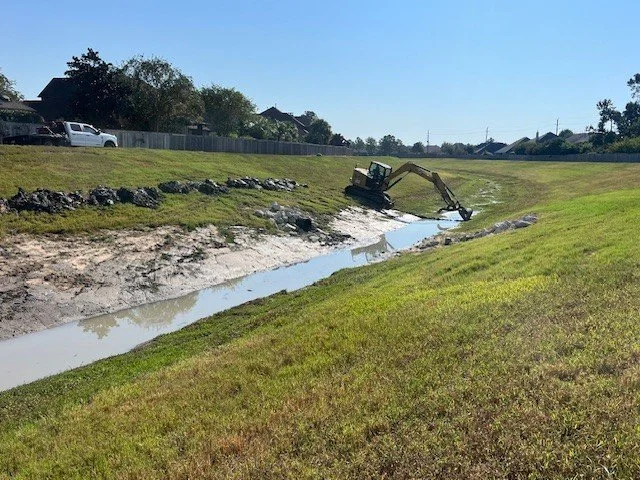
Budget season is the right moment for retention pond maintenance to come up, because a pond in Houston, TX rarely fails on a schedule that suits a property manager. It degrades quietly across two or three wet seasons and then presents itself as an emergency in the one year nobody set money aside for it.
The work is predictable. The timing is what catches properties out.
The Ethoscapes erosion control division works on stormwater infrastructure for MUDs, management districts, corporate campuses and HOA portfolios across the Greater Houston Area.
The pattern we see in the fall is consistent: the properties that budget calmly are the ones that walked the pond in October.
Related: Detention Pond Maintenance in Houston, TX: When a Basin Needs De-Silting
Why Does a Stormwater Pond Belong in a Capital Plan at All?
A stormwater pond belongs in a capital plan because it is infrastructure with a design capacity, and that capacity shrinks. Sediment arrives with every storm, settles, and takes volume away from the basin.
Nothing about that is visible from the parking lot, which is why pond work tends to be funded reactively.
A pond that is measured annually becomes a line item with a known trajectory instead of a surprise, and a board can plan around a trajectory in a way it cannot plan around an emergency.
What Should a Retention Pond Inspection Cover Before the Budget Is Set?
A pre-budget inspection should cover four things: sediment accumulation, shoreline condition, inlet and outlet performance, and vegetation.
Sediment depth is read against the original design grade, and the shoreline is checked for places where turf has given way and bare soil is sliding into the water.
The inlet and outlet are checked for obstruction and for whether each still moves water the way it was designed to. Vegetation gets read both ways, as growth that stabilizes a slope and as growth that chokes a channel.
Together, those four readings tell a board what the next three years look like.
How Does Pond Sediment Translate Into a Number on a Spreadsheet?
Pond sediment translates into a budget number through volume. Depth across the basin gives volume, and volume gives haul-off tonnage, which is what a removal project is priced against.
A pond measured two years running shows a rate of accumulation, and that rate turns into a projected year for the next desilt and a defensible figure to reserve against.
That’s the difference between telling a board that a pond will need attention at some point and telling them which budget cycle to plan it into.
Related: Commercial Landscape Maintenance in Houston, TX: How the Program Gets Measured Between Visits
What Does Shoreline Erosion Cost a Property If It Is Left Alone?
Shoreline erosion left alone compounds its own cost. A bare slope sheds soil into the basin, which accelerates the sediment problem the property is already paying to fix.
Erosion also undercuts whatever sits above the slope, which on many Houston properties is a sidewalk, a fence line or a maintained turf panel.
Stabilizing a slope while it is still a slope is ordinary work. Rebuilding one after it has failed is not, and the repair then reaches into the hardscape and the structures beside it.
Who Should Hold the Retention Pond Inspection Record?
The property should hold the inspection record, not the contractor. Records of condition, dated and measured, belong with the management file so they survive a change of vendor or a change of manager.
Every Ethoscapes erosion control project begins with a documented site review, and the full documentation is shared through the property’s Account Manager.
We provide records in that form on purpose, because a pond outlasts most of the people responsible for it.
Walk Your Retention Pond Before the Budget Numbers Are Due
If a stormwater pond sits on a property you manage in Houston, TX, an October walk with measurements behind it is worth more than a line in next year’s budget that was copied over from this year’s. Measured findings give a board a reason for the number, not only the number.
Ethoscapes will assess the basin, the shoreline and the structures and give you figures you can take to a board, the same work we carry for MUDs, management districts and HOAs across the Greater Houston Area.
Schedule your retention pond assessment with Ethoscapes.
In Summary
How often should a Houston stormwater pond be formally assessed?
Annually is a reasonable cadence for most commercial properties, with the assessment timed before the budget cycle so the findings are useful. Properties with heavy upstream construction often warrant a second look.
Is pond work something a grounds maintenance crew handles?
A grounds maintenance crew handles routine mowing of the slopes, but not the rest of the pond work. Sediment management, shoreline stabilization and structure repair sit with the Ethoscapes erosion control crew, which is a separate discipline with separate equipment.
What is the difference between a retention pond and a detention basin?
A retention pond holds a permanent pool of water. A detention basin is designed to be dry between storms and to release what it catches slowly. Both need attention, and they degrade in different ways.
Related: Commercial Landscape Contractor in Houston, TX: Scope Accountability on an Occupied Property